First Question:
The director of manufacturing at a cookies needs to determine whether a new machine is production a particular type of cookies according to the manufacturer’s specifications, which indicate that cookies should have a mean of 70 and standard deviation of 3.5 pounds. A sample pf 49 of cookies reveals a sample mean breaking strength of 69.1 pounds.
A. State the null and alternative hypothesis:
The Null: The mean breaking strength of cookie is at least 70.
The alternative hypothesis: The mean breaking strength is below 70.
B. Is there evidence that the machine is nor meeting the manufacturer’s specifications for average strength? Use a 0.05 level of significance
> a
<- 70
> s <- 3.5
> n <- 49
> xbar <- 69.1
> z <- (xbar-a)/(s/sqrt(n))
> z > 2*pnorm(-abs(z))
[1] FALSE
This proves the machine is meeting the manufacture specifications for average strength.
C. Compute the p value and interpret its meaning
> p <- 2*pnorm(z)
> p [1] 0.07186064
The null hypothesis is not rejected.
D. What would be your answer in (B) if the standard deviation were specified as 1.75 pounds?
> z <- (xbar – a)/(1.75/sqrt(n))
> z [1] -3.6
E. What would be your answer in (B) if the sample mean were 69 pounds and the standard deviation is 3.5 pounds?
> z <- (69 – a)/(s/sqrt(n))
> z [1] -2
Second Question:
If x̅ = 85, σ = standard deviation = 8, and n=64, set up 95% confidence interval estimate of the population mean μ.
The z-score for a 95% confidence interval is 1.96.
85 – 1.96( 8 / sqrt(64)) < 85 < 85 + 1.96( 8 / sqrt(64))
85 – 1.96 < 85 < 85 + 1.96
83.04 < 85 < 86.96
There is a 95% chance the population mean falls between 83.04 and 86.96.
Third Question using Correlation Analysis
a. Calculate the correlation coefficient for this data set
> x <- c(49, 46.1, 19)
> y <- c(50, 54.2, 22)
> z <- c(69, 67.7, 28)
> df<- data.frame(x,y,z)
> cor(x,y)
[1] 0.978446
b. Pearson correlation coefficient
> a<- cor(df,method = “pearson”)
> a
x y z
x 1.0000000 0.9784460 0.9982097
y 0.9784460 1.0000000 0.9890455
z 0.9982097 0.9890455 1.0000000
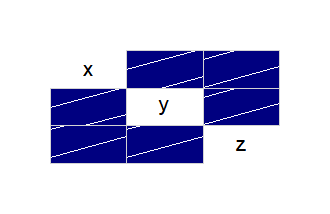
c. Create plot of the correlation
corrgram(a)
 Mack's Stats
Leave a comment