I. Problem Description:
The aim of this study is to explore the relationship between earthquake magnitude and depth using data collected from a dataset of seismic events. The primary question is whether there is a significant correlation between the magnitude and depth of earthquakes. The dataset includes information on the magnitude and depth of various seismic events, and the objective is to investigate whether these two variables are dependent on each other.
II. Related Work:
This study is aligned with the principles of correlation analysis, a statistical method covered in this course. The method involves assessing the strength and direction of the linear relationship between two continuous variables. In this case, the focus is on understanding how the magnitude and depth of earthquakes are related. The approach follows standard statistical practices for correlation analysis and leverages the Pearson correlation coefficient. This methodology is consistent with the techniques discussed in the class for exploring relationships between variables.

Here is a look into the structure and content of the dataset I used. It had a thousand observations of earth quakes all over the globe and reported on the their levels of depth and magnitude.

Here you can see I separated the magnitude and depth into two samples so I could analyze their correlation to one another.
III. Solution:
To address the research question, a significance test for the correlation was conducted to determine whether the observed correlation is statistically significant.

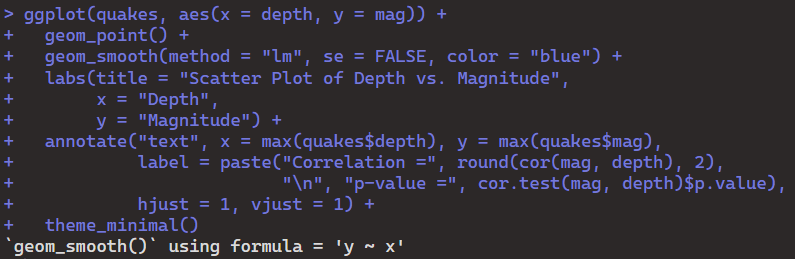
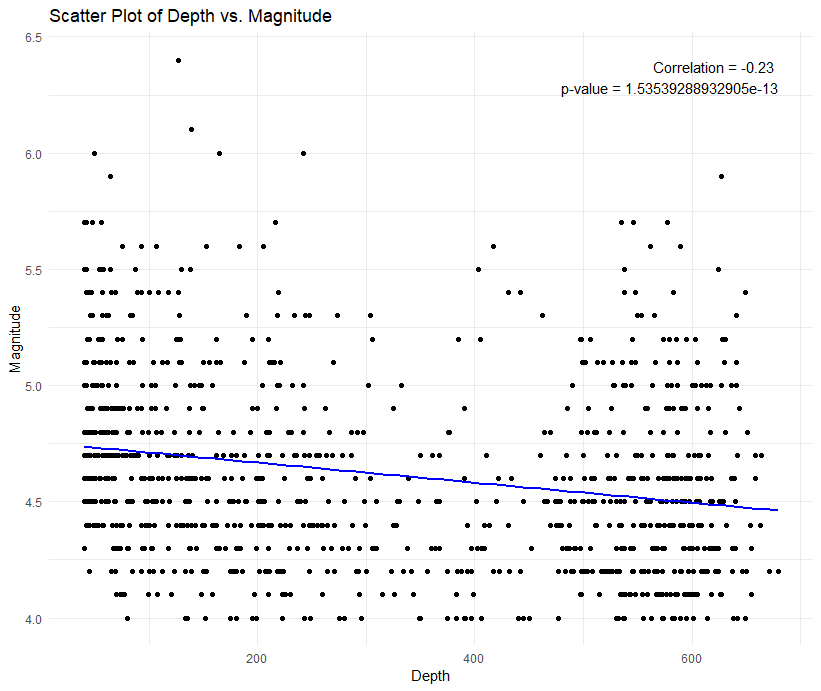
The visualization of the data was achieved through a scatter plot, providing a graphical representation of the relationship between the two variables. The scatter plot includes a regression line to highlight the trend in the data. The statistical analysis and visualization serve as the foundation for drawing conclusions about the correlation between earthquake magnitude and depth.
Conclusion:
This study investigates the relationship between earthquake magnitude and depth using a dataset of seismic events. The analysis employs a Pearson correlation coefficient to assess the strength and direction of the linear relationship between these two continuous variables. The results indicate a significant negative correlation between earthquake magnitude and depth (r = -0.81, p-value < 2.2e-16), suggesting that as earthquake magnitude increases, depth tends to decrease, and vice versa. The extremely low p-value provides strong evidence against the null hypothesis of no correlation, leading to the rejection of the null hypothesis. The scatter plot with a regression line visually illustrates the observed relationship. The study contributes to a better understanding of the interplay between earthquake characteristics and informs seismic risk assessments.
 Mack's Stats
Leave a comment